The price tag isn't the only challenge in high-ticket sales. The core issue is that every serious deal now begins with research, and most reps still rely on generic outreach, stale lists, and lack signal context. If your team spends the day digging through tabs, updating CRM fields, and sending the same opener to every account, the pipeline gets noisy fast and good accounts slip away.
For outbound teams, high ticket sales meaning has changed. It's no longer just “expensive offers sell differently,” it's “buyers expect you to know who they are, why they matter now, and what triggered the conversation before you ever hit send.” That's why this category burns reps out so quickly, and why signal-backed research has become the actual lever, not clever copy.
Why High Ticket Sales Is Suddenly a Research Problem
SDRs and BDRs don't usually lose their day to selling. They lose it to finding out who to sell to, why now, and what to say first. In a high-ticket motion, that pain gets worse because the account work is heavier, every prospect needs stakeholder mapping, and every message has to land like it was written for one specific buying committee instead of one generic ICP.
That's why the old “spray and pray” habit falls apart here. If a rep is already buried in manual account research, then blasting the same pitch to a high-value list is just a faster way to waste more of the same day. The bleed is real, the math is ugly, and the fix is not more hustle, it's better signal collection and better list preparation.
Practical rule: if the rep can't explain the trigger, the stakeholder, and the likely objection before the first touch, the account is not ready for generic outbound.
High ticket sales meaning becomes operational rather than theoretical. The definition matters because it tells you whether the work is about volume or precision, and high-ticket work is almost always the second one. A rep chasing a low-fit lead can survive on a decent opener, but a rep working a serious deal needs timely context, a clean angle, and a reason to believe the buyer is already in motion.
That's also why signal orchestration matters more than raw list size. The team that can gather signals in bulk, sort the list by buying relevance, and turn those signals into conversational hooks will outwork a team that keeps researching accounts one at a time. The first team creates pipeline from evidence. The second team creates activity.
What High Ticket Sales Actually Means in B2B
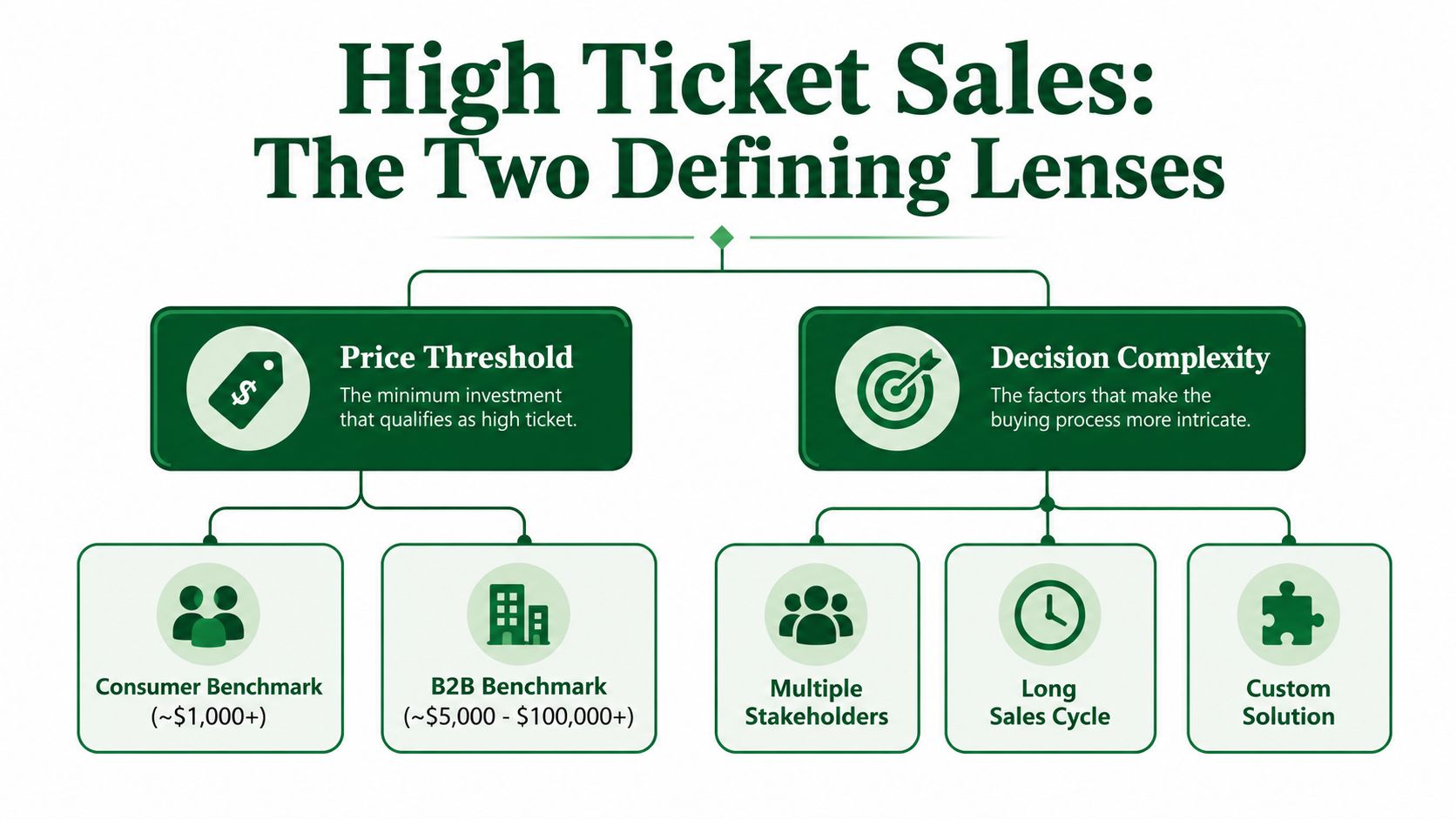
The cleanest way to define high-ticket sales is to use two lenses at once, price threshold and decision complexity. Industry explanations commonly place the floor around $1,000+ in consumer contexts, while B2B deals often start around $5,000 to $10,000+ and enterprise work moves into $50,000 to six- or seven-figure territory, though different guides use working minimums like $2,000, $3,000, or $5,000 depending on the market (SendTrumpet's 2025 high-ticket sales overview). That spread matters. High-ticket is market-relative, not legally standardized.
The price alone still does not tell the full story. A high-ticket deal is usually the one that triggers a formal buying process, and that process changes the sales motion. In B2B, the seller often has to work through multiple stakeholders, budget approvals, legal review, and evaluation cycles that can stretch for months. That is why two offers with similar price tags can behave very differently in outbound.
Working definition for pipeline teams
High-ticket sales are deals where the decision requires enough internal scrutiny that the buyer needs evidence, not just interest.
That definition is practical because it lets a team classify deals without guessing. If a sale needs one person, a card, and a quick yes, it is not high-ticket in the operational sense. If the deal needs procurement, finance, legal, or multiple department heads, it belongs in the high-ticket bucket even if the sticker price looks moderate.
The fastest way to sort your own motion is simple. Look at the contract value, then look at the number of people who must sign off, the amount of justification required, and how long the buyer is likely to deliberate. If all four indicators rise together, the deal behaves like high-ticket work. If only one of them is high, you may be in a different category entirely.
For teams that want adjacent operational context, the broader outbound playbook is laid out in PitchSmart's outbound sales blog, and the main takeaway stays the same. High-ticket is not a bigger version of transactional selling, it is a different buying process altogether.
Buyer Psychology Behind Every High Ticket Purchase
A high-ticket buyer is not just evaluating a solution, they are also evaluating the downside of being wrong. That pressure shows up in four places, personal risk, professional risk, stakeholder pressure, and evaluation drag. A VP of Operations looking at a platform that could change reporting, tooling, and internal workflows is not buying with the same mindset as someone trying a self-serve app. The second purchase can be quick. The first one can put budget, credibility, and internal momentum on the line.
Risk changes the tone of the sale
High-ticket buyers are protecting themselves as much as they are buying a solution. They worry about the wrong vendor, budget overcommitment, and having to defend the decision after the fact. Once the price rises, the seller's role shifts from pitch-heavy to consultative, because the buyer wants evidence that lowers perceived risk, not a pressure sequence that raises it.
Trust and consensus matter more than enthusiasm
A single enthusiastic contact rarely carries the deal once the purchase matters. High-ticket purchases trigger a formal buying process involving multiple stakeholders, budget approvals, legal review, and evaluation cycles that can stretch for months. That reality changes the work before first contact. SDRs and BDRs need to know who is likely to weigh in, what kind of proof each person will expect, and which objections will show up after the first reply gets forwarded internally.
The first email is not trying to close the deal. It is trying to earn the second conversation.
Outbound gets punished fast when the buyer can tell the rep did not do the work. Generic cold email does more than underperform in this category, it signals low relevance in a process that already asks the buyer to take on more risk. If the opener could have gone to 200 other accounts, the buyer assumes the rest of the motion is just as shallow. In a long-cycle deal, that impression tends to stick.
Pricing context belongs in the research phase too. A rep who understands pricing signals and package fit can shape outreach around the buyer's likely internal discussion instead of sending a vague pitch and hoping someone builds the case later.
High Ticket vs Low Ticket Sales Side by Side
| Dimension | High Ticket | Low Ticket |
|---|---|---|
| Deal value | Usually higher, often tied to strategic budget approval | Lower, often bought with less scrutiny |
| Sales cycle | Longer, with more follow-up and internal alignment | Shorter, often impulse-friendly |
| Stakeholders | Multiple people may influence or approve the decision | One buyer often decides alone |
| Message depth | Requires context, proof, and tailored relevance | Can lean on simple benefits and fast clarity |
| Rep activity mix | Research-heavy, fewer touches, more personalization | Volume-heavy, lighter research, more repetitive outreach |
The practical difference is not just price, it's time allocation. A rep who can send dozens of low-touch emails in a day cannot do the same thing on a high-ticket account list without cutting corners somewhere important. In high-ticket work, the cost of a shallow message is higher because every account has more moving parts and a worse generic fit looks even worse.
That's where many teams break their own motion. They keep the same cadence, the same templates, and the same research habits, then wonder why meetings don't convert into real pipeline. The issue is usually not the rep's effort. It's the mismatch between the motion and the buying process.
Operational test: if your sequence can't adapt to stakeholder complexity, it's built for low-ticket volume, not high-ticket selling.
For pricing context, PitchSmart's pricing page is relevant for teams evaluating tooling, but the broader point here is about motion design. High-ticket outbound needs fewer blind sends and more account-specific work. Low-ticket sales can tolerate a wider net. High-ticket sales punish it.
The High Ticket Sales Process and KPIs for Each Stage
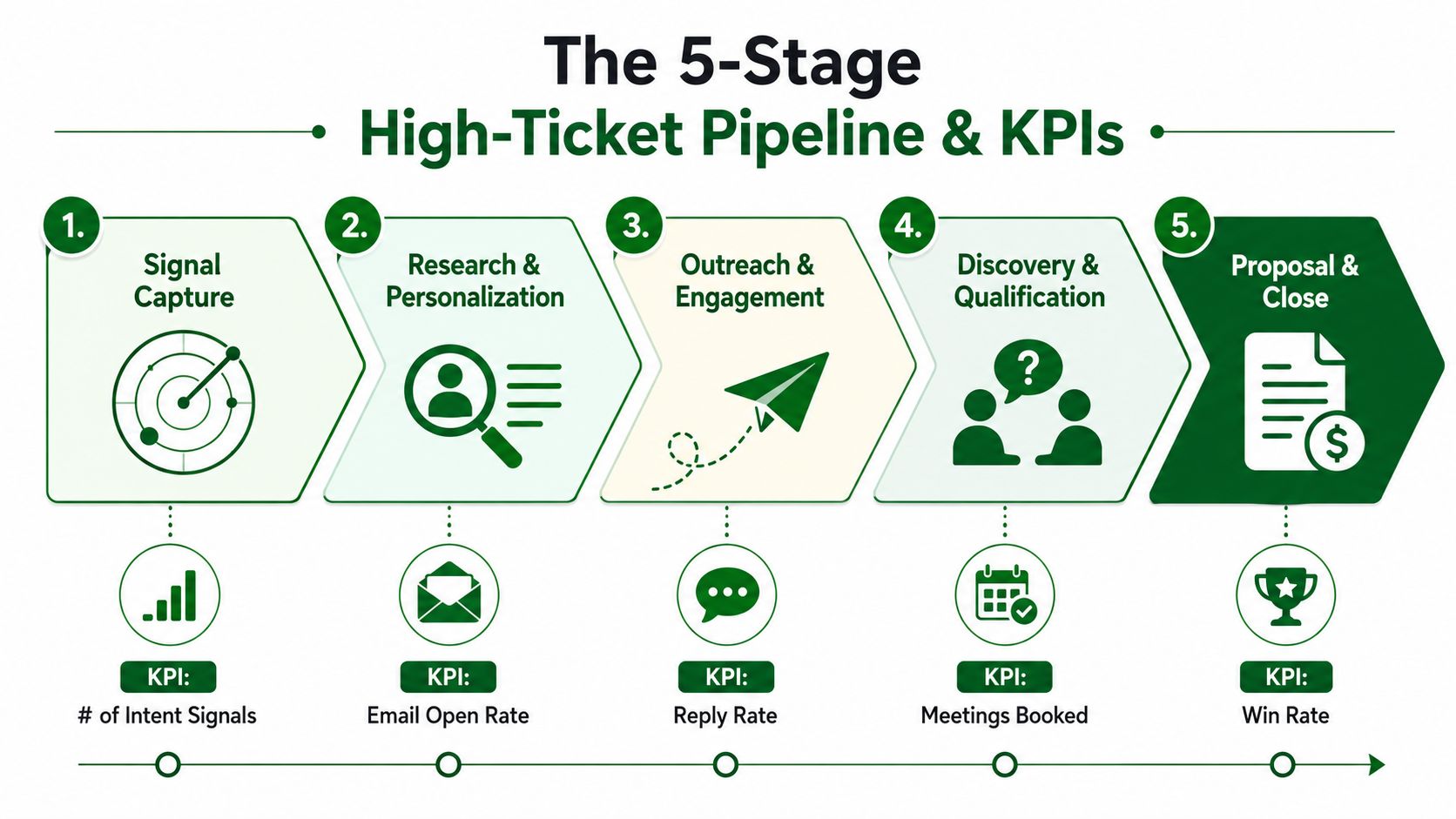
The high-ticket pipeline behaves best when each stage has one clear job. If a team tries to force every stage to do everything, reps start guessing, managers lose visibility, and pipeline reviews turn into storytelling instead of control. A better way is to track the movement from signal to sale, then assign one KPI to each handoff.
Stage logic that actually holds up
- Signal capture. Buying signals are sourced and sorted here. The KPI is simple, the number of intent signals that are attached to real accounts, not just names in a list.
Research and personalization. The rep turns the signal into a specific opener. The KPI here is whether the message is strong enough to earn attention, which is why teams usually monitor email open rate or a similar early engagement indicator.
Outreach and engagement. The goal is a real reply, not a vanity send. Track reply rate and look at whether the message starts a relevant conversation instead of a brush-off.
Discovery and qualification. Now the rep checks fit, urgency, and stakeholder reality. The KPI is meetings booked, but only meetings with the right level of seriousness count.
Proposal and close. Consensus, scope, and ROI arguments matter. Measure win rate, because high-ticket deals can look healthy early and still collapse if the value case is weak.
Apollo's buyer-first framing puts many B2B high-ticket deals at $5,000+, with timelines often stretching 60 to 180 days because larger commitments raise perceived risk and require more internal alignment before purchase (Salesforce). That timeline is why process discipline matters. Reps who treat every stage as research-heavy usually out-convert reps who treat the whole thing like a volume game.
Qualification Signals and Outreach Tactics for SDRs
High-ticket outbound works when the signal arrives before the message. That means the SDR or BDR should prioritize events that make the account more likely to care right now, such as role-specific hiring posts, recent funding, tech stack changes, leadership turnover, and expansion announcements. Each one shortens the distance between “interesting vendor” and “we should look at this.”
Signals that deserve first attention
- Hiring tied to the problem you solve. If a team is recruiting for the exact workflow your product supports, the need is already public.
- Recent funding. New capital often creates room for new tooling, new hires, and new infrastructure decisions.
- Tech stack changes. A migration or replacement project can create urgency around better process and cleaner reporting.
- Leadership turnover. New executives often revisit tools, budgets, and operating standards quickly.
- Expansion announcements. Growth usually creates a need for scale, consistency, and tighter systems.
Recent guidance in the sales category recommends responding to high-ticket leads within 30 minutes and pairing that speed with personalized, dream-client targeting and CRM-based lead scoring (Getspear). Speed matters because the signal is freshest when the buyer's attention is still active.
Turning one signal into a message
If a company just hired a new RevOps leader, the opener should not ask if they need help with revenue operations. It should reference the hire, connect it to a likely operational priority, and ask a narrow question. That same logic can drive a 3-step email and LinkedIn sequence, one email to acknowledge the signal, one follow-up to add a relevant proof point, and one final touch that offers a clean next step.
The operational answer is bulk research, not one-off detective work. The same research layer should run across the full list, then attach sourcing back to each signal so the rep can build outreach from evidence instead of memory. That is the difference between personalization that scales and personalization that collapses under workload.
Two SDRs Two Pipelines A Realistic Example
SDR A starts Monday with a purchased list and no signal context. By Friday, they've sent 200 generic emails, booked two meetings, and both meetings are with low-fit prospects who wanted a quick demo but never had a real business case. The week felt busy, but the pipeline barely moved because the outreach ignored the actual buying state of the accounts.
SDR B works a smaller list, but every account has been segmented by a real trigger. The rep spends the first pass researching the signal, the likely stakeholder, and the relevant business context, then sends a sequence built around those hooks. By the end of the week, they've booked four meetings with qualified stakeholders because the opener sounded informed enough to get past the first filter.
That difference isn't magic, it's the advantage of research. SDR A spends the time manually stitching together context account by account, while SDR B uses a workflow that lets the same signal work across the whole list. The second motion is harder to fake and easier to scale because the rep isn't guessing at fit every time.
What changes downstream is just as important. The qualified meetings have a better shot at turning into real opportunities because the buyer already saw relevance before the call. That's the part many teams miss when they focus only on meeting volume. In high-ticket sales, the quality of the research shows up later in the cycle, not just in the reply.
Your 30 Day High Ticket Outbound Reset
High-ticket sales meaning comes down to decision complexity, and decision complexity is won through research depth, not send volume. The clean reset is simple, audit your signals in week one, run bulk research across the best accounts in week two, rebuild sequences around the strongest hooks in week three, and instrument the KPIs from the pipeline section in week four.
A practical checklist for the next month
- Clean the list. Remove accounts with no real fit, no reachable contact, or no signal.
- Attach sourcing. Every account needs a reason for being contacted now.
- Rewrite the opener. Use one concrete business trigger, not a generic pitch.
- Measure the handoff. Track whether signals turn into conversations, meetings, and proposals.
The best teams compress the first two weeks by using tools that can research the full list in parallel, tie each clue back to its source, and seed outreach from the best hooks. That's the working standard now, not because it sounds elegant, but because reps can't afford to spend half the week manually assembling context anymore. If you want to tighten that loop, PitchSmart is built for exactly that workflow.
PitchSmart helps outbound teams replace manual research with bulk account research, signal-backed scoring, and outreach built from real buying context. If your high-ticket motion is getting stuck in generic emails and slow prep, visit PitchSmart and see how much faster your team can turn signals into qualified conversations.