Clay and Apollo end up on the same shortlist because both will hand you an email address for a person at a target account. That overlap is real, and it is also about the only thing the two products share. One is a contact database with a sales engagement suite built around it. The other is a build surface that pulls data from many providers and does whatever you wire it to do. Comparing them feature by feature produces a long table and no decision.
The faster route is to split the comparison into two separate questions. The database question: where do your contacts come from, and what does each record cost you? The workflow question: who builds the process, who maintains it, and where do the emails actually get sent? Most teams already know their answer to one of those. Once you name it, the choice mostly makes itself. There is also a third question that neither tool answers by default, and it is the one that decides whether the list turns into pipeline. We will get to it last.
What each product actually is
Apollo describes itself on its homepage as a platform with "240M+ contacts and 30M+ companies", and it wraps that database with the rest of an outbound stack: email sequencing and multi-touch campaign workflows, a dialer, form enrichment, visitor identification, meeting scheduling and deal boards. You search the database, reveal contacts, and put them into a sequence without leaving the product. Pricing on its pricing page is per seat, with a credit allowance attached to each plan.
Clay does not sell you a database of its own in the same way. Its pricing page describes a marketplace of data from 200+ providers, a spreadsheet-shaped table where each column can be an enrichment, a formula, or a research step run by its AI agent, and "multi-provider waterfalls" listed from the Free plan up. You bring the list, decide which providers to try in which order, and send the result somewhere else. Clay is priced by the workspace on two meters, data credits and actions, and the Free plan lists unlimited seats.
So the first thing to notice is that the two products charge for different things. Apollo charges per person who logs in. Clay charges per unit of data and work the table consumes. A ten-rep team with one ops person building lists will get a very different bill from each, and neither bill is obviously smaller until you know how many records you need and how many people touch the tool.
The database question: where contacts come from
If your problem is coverage (you cannot find emails or direct dials for the people you want), this is the question that matters, and the two products answer it with opposite designs.
Apollo is a single source. When you search, you are searching its database, and when you reveal a contact, you pay in Apollo credits. Two details from Apollo's credits page change how you should plan: you are "only charged credits for email addresses that Apollo can verify," and credits "expire at the end of each billing cycle" with no rollover. A team that buys a large allowance for a quarter-end push and then goes quiet does not bank the remainder.
Clay is many sources in sequence. The waterfall runs your first-choice provider, and only the records it misses go to the next one. Clay's documentation on actions and data credits puts a fully enriched record at typically 6 to 20 data credits, depending on which data types you ask for, and notes that emails are cheap and phone numbers are expensive. Its FAQ on unsuccessful searches is explicit that "You'll only be charged Data Credits when Clay successfully returns data," and that once validated data comes back, later waterfall steps stop consuming credits.
Both vendors, then, charge for hits and not misses. The difference is what a miss means. In Apollo, a miss is a miss. In Clay, a miss at step one is an attempt at step two. That is why teams selling into markets a single database covers thinly (outside the US, or in industries without a big software buyer population) tend to reach for a waterfall, and why teams selling into well-covered segments often never need one.
| Question | Apollo | Clay |
|---|---|---|
| Where the data comes from | Its own database, 240M+ contacts and 30M+ companies by its own count | A marketplace of third-party providers, run in the order you choose |
| How you pay | Per seat, with a credit allowance per plan | Per workspace, on data credits and actions |
| What a failed lookup costs | Charged only for emails it can verify | Data credits charged only when data is returned |
| Unused allowance | Credits expire at the end of the billing cycle | Check the plan terms on the pricing page before committing annually |
| Where outreach happens | Inside Apollo: sequences, dialer, scheduler | Usually in another tool you send the rows to |
| Who has to maintain it | Reps and a light admin | Someone who builds and owns the tables |
If you want the broader field before narrowing to these two, the comparison of data enrichment tools covers the other options on the same axes.
The workflow question: who builds, who sends
This is the question teams skip, and it is usually the one that decides whether the purchase works six months later.
Apollo is a finished workflow
Apollo ships with the process already assembled. A rep can search, filter, reveal, add to a sequence and start calling from one place. For a team without a dedicated operations person, that is most of the value: nobody has to design the pipeline between data and outreach, because the vendor already did. The cost is that you work the way the product works. If your process needs a step Apollo does not have, you either skip the step or add a tool.
Clay is a workflow you build
Clay's documentation describes actions as "the orchestration you do in Clay: enriching data, running AI research, and sending data to other tools." That last phrase is the design. Clay sits between your list and your sequencer, and what happens in between is whatever someone built. That is powerful when the someone is good and still employed. It is fragile when they leave, because a Clay table encodes decisions (which providers, in which order, with which filters) that are rarely written down anywhere else. The Clay alternatives piece covers that departure as one of the three common reasons a team starts shopping.
Tool count is a real cost
Adding Clay usually means adding a sending tool too, since the sequence lives elsewhere. That matters more than it sounds. Salesforce's State of Sales statistics, drawn from a survey of more than 4,000 sales professionals, report that sellers use an average of 8 tools to close deals, that 42% of reps feel overwhelmed by too many tools, and that reps spend 60% of their time on non-selling tasks. A stack that gives ops more control can quietly give reps more tabs. If the people doing outreach are not the people building the table, decide up front how results reach them. The sales engagement platform guide covers what that receiving end needs to do.
Pick by the shape of your team
With both questions answered, most teams fall into one of four shapes.
- A small team, no ops hire, selling into a well-covered segment. Apollo. You get data and outreach in one place, and nobody needs to maintain a build. Watch the credit expiry if your volume is lumpy.
- A team with an ops or growth engineer and a thin-coverage market. Clay. The waterfall earns its keep when one database misses a large share of your list, and you have the person to own the tables.
- A team already paying for a sequencer and a CRM. Lean toward Clay, or toward your CRM's own enrichment, before buying a second engagement suite. Apollo's sequencing is part of what you pay for per seat. The CRM data enrichment guide covers the in-CRM route.
- A team that has both and cannot say which one produces pipeline. Keep the one whose output your reps actually use and measure the other against it for a quarter. Running both is common. Running both without knowing why is expensive.
A useful test before signing: take 200 accounts from your real target list, run them through a trial of each, and count verified emails for the roles you actually sell to. Coverage claims at the scale of hundreds of millions of contacts tell you nothing about your 200.
The question neither answers by default: why call this account now
Say you picked well. Every account on the list now has the right contacts with verified emails. A rep opens row 47 and has a name, a title and an address. What they do not have is a reason that this account needs what you sell this quarter. Both tools answer "who" and "how do I reach them". Neither, out of the box, answers "why now, for our product".
That gap is where lists go to die. A contact record with no reason attached gets a generic first line, and generic first lines are what buyers learn to ignore. The fix is research against what you sell: a new sales leader arriving, a hiring surge in the team your product serves, a funding round with a stated plan to grow a function. The buying signals guide goes through how to define those for a specific product, and trigger events in sales covers which events tend to hold up.
To be fair to Clay, you can build this in a Clay table. Its plans include AI research steps and job change signals, and a skilled builder can write prompts that look for specific events per account. The cost is the same as the rest of Clay: someone has to design it, keep it working, and decide what counts as a real signal for each product you sell.
This is the part PitchSmart does. You add what you sell, it drafts the buying signals that would mean an account needs it, you review them, and it researches every account on your list against those signals, returning each finding with its source. It does not replace a contact database or a sequencer. It gives the rep on row 47 the reason to call and the link that proves it.
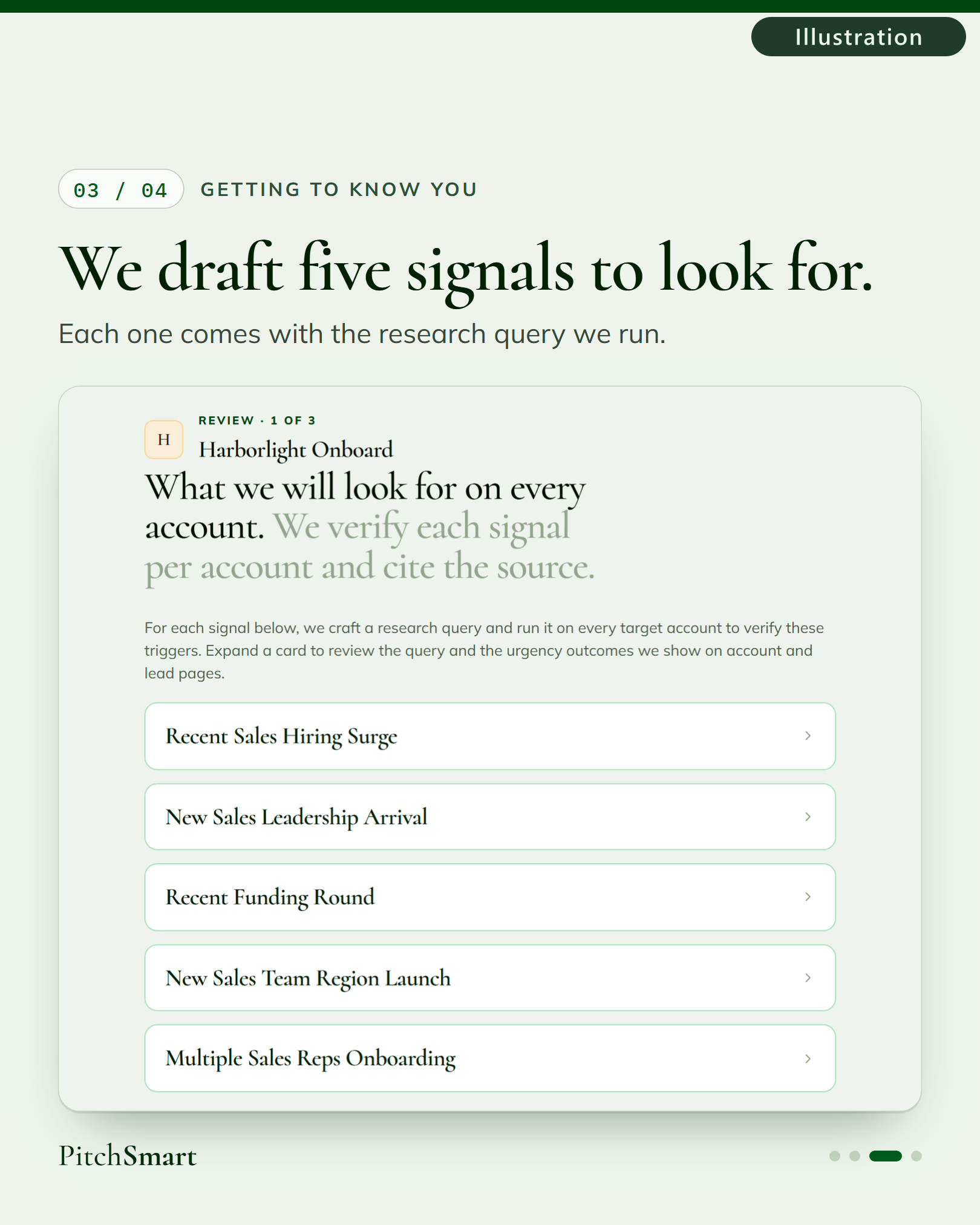
Illustration from a PitchSmart demo account. The company shown is invented. This is the review step for one product: each of the five signals comes with a research query that runs on every target account, and the outcome is shown on account and lead pages with its source. To draft signals for what you sell and run them on your own list, start a free trial.
A decision checklist
- Write down how many records you need per month and how many people will log in. Price both tools on those two numbers, not on the plan names.
- Run the same 200 real accounts through a trial of each and count verified contacts for your buyer roles.
- Name the person who will own a Clay build. If there is no name, weight Apollo heavily.
- List the tools you already pay for that send email. If there is one, you may not need Apollo's sequencing.
- Decide how each contact will reach a rep with a reason to call, and who produces that reason. If the answer is "the rep will research it", count that time as a cost of whichever tool you pick.
Clay versus Apollo is a real choice with a real answer for your team, and it is a choice about data and process. Make it on those terms, then solve the reason-to-call problem separately, because neither purchase solves it for you.